Hitachi UX-300 is an ester refrigeration oil specified at 250 to 310 mm²/s at 40 °C. Hitachi's service manual for the RCUE and RHUE air-cooled screw chillers names it as the charge oil for R407C machines. Those two facts settle most purchase questions: the base oil is ester, and the grade is a viscosity band rather than a single number.
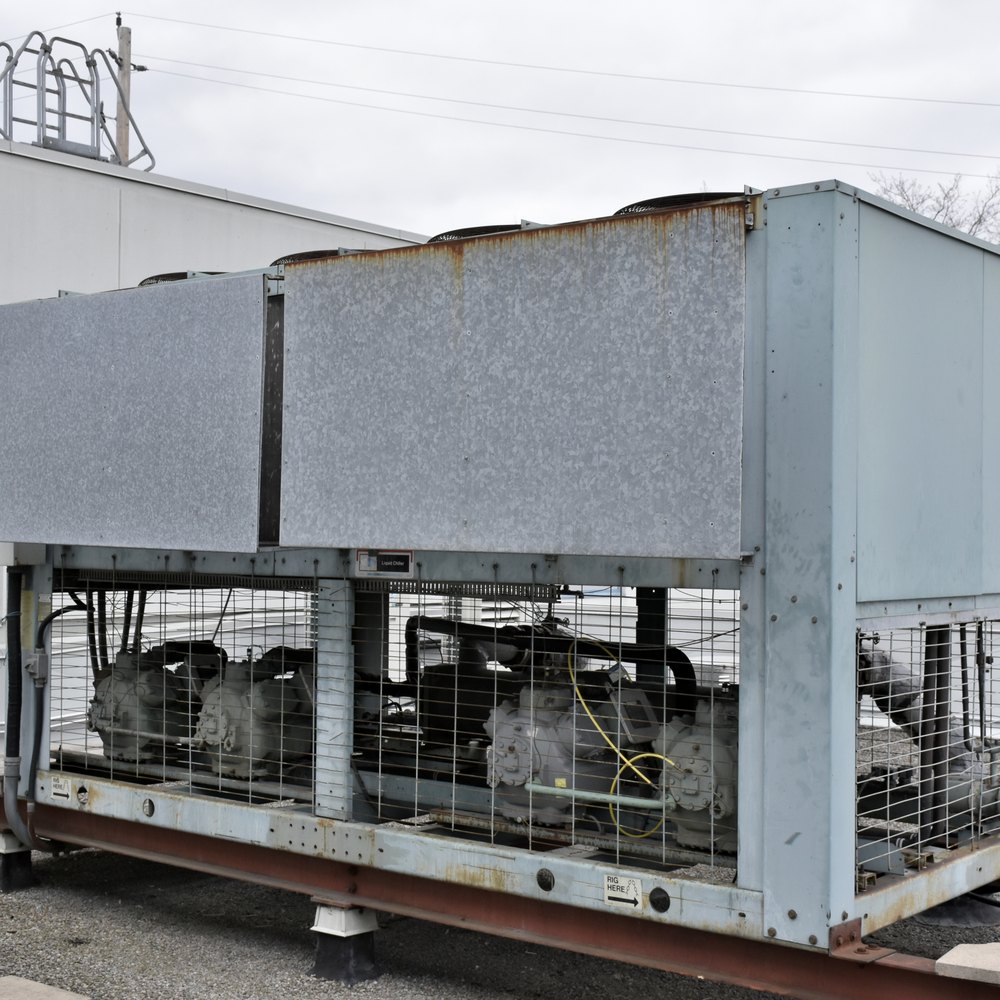
Section 6.6.2 of the Hitachi service manual for the RCUE and RHUE AG2 series describes the refrigerant oil as an ester series synthetic oil and names Freol UX300 of Japan Energy as the product. The reason given is compatibility with R407C, the refrigerant used in those chillers.
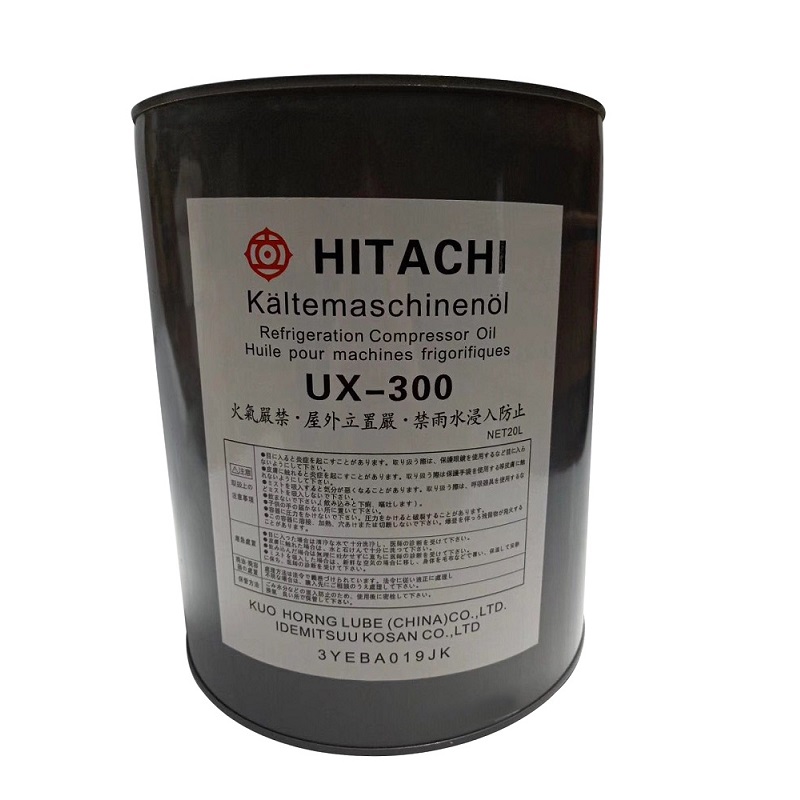
The 20 litre pack carries the HITACHI UX-300 name, the German line Kältemaschinenöl, the English line Refrigeration Compressor Oil, and a manufacturer line reading KUO HORNG LUBE (CHINA) CO., LTD and IDEMITSU KOSAN CO., LTD. The net content printed on the label is 20 litres.
Qishanr supplies the grade in 20 litre pails, with a net weight of about 21 kg per pail. The UX-300 product page carries the current pack and quotation route.
The manual gives the oil as a table rather than a single figure, and the viscosity is a range.
| Property | Value in the Hitachi manual |
|---|---|
| Oil type | Ester series synthetic oil |
| Oil name | Freol UX300 of Japan Energy |
| Kinematic viscosity at 40 °C | 250 to 310 mm²/s |
| Fluid point | Below −20 °C |
| Water saturation | Approximately 1600 ppm |
| Refrigerant context | High compatibility with R407C |
A band of 60 mm²/s is wide enough that two oils inside it can differ by a fifth of the value. For a chiller compressor that difference is small in film terms and large in paperwork terms: a supplier who quotes "300" without a measured figure has not told you where in the band the oil sits. Ask for the 40 °C kinematic viscosity and compare that number to 250 to 310.
The fluid point matters on the low side. Below −20 °C is the figure the manual states for the oil as supplied.
ISO viscosity grades are fixed bands defined at 40 °C, and they do not include a grade numbered 300. The UX-300 band starts above the top of ISO VG 220 and continues into ISO VG 320 territory, so no single ISO grade label describes the oil.
That has a practical consequence at the quotation stage. A product described only as ISO VG 320 covers part of the UX-300 band, not all of it. A product described only as ISO VG 220 falls below the band entirely. The number to compare is the measured viscosity at 40 °C.
The same manual page compares UX-300 with Castrol Icematic SW220HT on one point. It states that the hygroscopicity is the same, and that both are ester series refrigeration oils. The practical instruction attached to that comparison is to keep both oils open to ambient air for as short a time as possible.
That comparison covers water behaviour and base oil family. It does not state that SW220HT is a viscosity-equivalent replacement for UX-300, and the 220 in that product name is not the same statement as the 250 to 310 mm²/s band. A buyer working from that comparison still needs the measured 40 °C viscosity of the oil on offer, set against the OEM band, before treating it as a fit.
The manual puts water saturation at approximately 1600 ppm.
The handling rule that follows is simple. Keep pails closed until the moment of use, open them to ambient air for as short a time as possible, and avoid leaving a part-used pail open between service visits. For scheduled maintenance, order the pail count the job needs rather than opening a pail for a partial fill.
The manual is direct on mixing: other refrigerant oil cannot be used, and attention is needed at maintenance so the charge is not mixed with another oil. On an R407C machine the oil circuit is an ester circuit, and mineral oil introduced during a top-up changes the chemistry of the whole charge.
In practice that means a chemistry change is a drain and flush job, not a top-up. When a compressor is replaced or a charge is renewed, the oil that goes back in should be the grade the machine was built around, at the viscosity inside the OEM band.
The manual pairs each chiller size with a compressor reference and a factory R407C charge. That pairing is the first cross-check when a service team asks which oil a machine takes, because the chiller model identifies the circuit.
| Chiller model | Compressor reference | R407C factory charge |
|---|---|---|
| RCUE40AG2 | 8E041072 | 39 kg |
| RCUE50AG2 | 8E051072 | 46 kg |
| RCUE60AG2 | 8E061072 | 41 kg |
| RCUE80AG2 | 8E081072 | 64 kg |
The table continues through RCUE400AG2. The compressor is listed as a semi-hermetic screw type, the refrigerant as R407C factory charged, and the oil as JAPAN ENERGY FREOL UX300 (Ester) on every model in the range.
The maintenance section of the same manual lists the lubricant oil as a service item in its own right, under the line "Check of lubricant oil and change it". The surrounding schedule sets the routine points:
| Interval in the manual | Work listed |
|---|---|
| Daily | Record operating situation: pressure, temperature, voltage, current |
| Every 6,000 hours or one year | Operation check of safety and protection devices |
| 24,000 hours or five years, air-cooled | Overhaul check of compressor and parts |
| 40,000 hours or five years, water-cooled | Overhaul check of compressor and parts |
The manual adds two instructions that matter more than the numbers. Take the shorter period when two intervals compete, and add work items according to the purpose and conditions of use. A chiller on continuous process duty and a chiller on seasonal comfort cooling do not see the same oil life inside the same calendar window.
Three statements in the manual sit next to the oil specification and affect any service that touches the charge.
The organic materials used in the compressor and control devices, including rubber and teflon parts, are specified as compatible with Freol UX300 and R407C. That is a statement about the sealing and insulation materials in the circuit, and it is the reason a substitute oil with a different base chemistry is a materials question as well as a viscosity question.
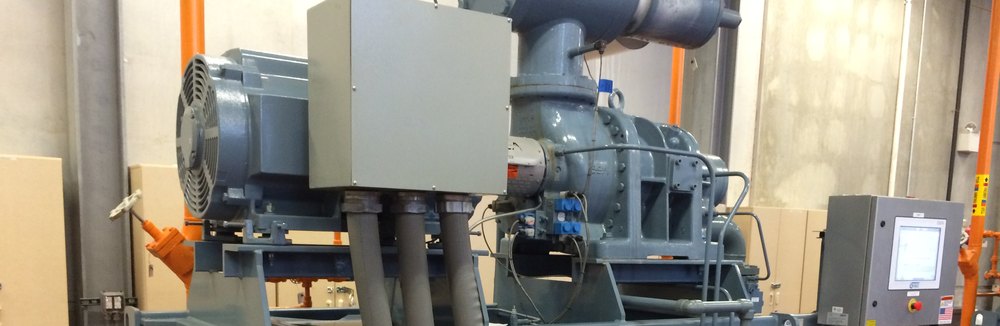
R407C runs at a higher pressure than R22, and the manual states that R407C devices are not compatible with R22 devices. Compressor and cycle parts replaced at maintenance have to be the specified parts for the refrigerant in the unit.
The third statement is blunt: do not put R407C into units built for R22. The same logic runs the other way for oil, since an R22 machine is a mineral oil machine and an R407C machine is an ester machine.
Three details connect the oil to the equipment. Two are on the machine and one is in the manual.
| Check | Where it is stated |
|---|---|
| Chiller series and size | Model plate, for example RCUE80AG2 |
| Refrigerant | Model plate and the refrigerant charge label |
| Compressor reference | The manual lists one per model, for example 8E081072 for RCUE80AG2 |
From the manual, the RCUE AG2 range runs from RCUE40AG2 to RCUE400AG2, and the RHUE AG2 range from RHUE40AG2 to RHUE240AG2. Send the model, the refrigerant confirmation, the number of circuits on the unit, the pail quantity and the destination port, and the quotation can be built against the machine instead of against a name.
The grade has a second role beyond identification. The manual specifies it for R407C service in these chillers, and the viscosity band is what a replacement has to reproduce. The existing guide to UX-300 in service covers the maintenance side, including the checks that decide when a charge is finished.
For the refrigerant side of the same decision, the HFC oil compatibility guide sets out which oil families pair with which HFC refrigerants, and the POE and mineral oil comparison explains why an ester charge and a mineral charge are not interchangeable.
Yes. The Hitachi manual classifies it as an ester series synthetic oil, which is the polyol ester family used with HFC refrigerants.
The manual specifies 250 to 310 mm²/s kinematic viscosity at 40 °C, with a fluid point below −20 °C.
The manual compares the two on water behaviour: it states that both are ester series refrigeration oils and that the hygroscopicity is the same. Viscosity is not part of that comparison, so the 40 °C figure still has to be checked against the 250 to 310 mm²/s band.
No. The manual states that other refrigerant oil cannot be used and that the charge must not be mixed at maintenance.
The RCUE AG2 chillers pair it with semi-hermetic screw compressors. The manual lists a compressor reference for each chiller size, from 8E041072 on RCUE40AG2 through the range to RCUE400AG2.
The maintenance schedule lists oil check and change as a service item, with routine points at 6,000 hours or one year for safety and protection checks, and overhaul checks at 24,000 hours or five years for air-cooled units and 40,000 hours or five years for water-cooled units. The shorter period applies when two intervals compete.
The pack is 20 litres, with a net weight of about 21 kg per pail. State the pail count and destination port when requesting a quotation.
For a grade check against your chiller, send the model, refrigerant and pail quantity through the UX-300 product page or contact the Qishanr technical team directly.
This article was first published by QishanrLubricants on October 26, 2026. When you quote its figures, specifications, test data or conclusions, please credit QishanrLubricants and link to the original article. © 2026 QishanrLubricants. All rights reserved.
Technical values are taken from the Hitachi service manual for the RCUE and RHUE AG2 series, document SMGB0003 rev.0, section 6.6.2. The manual is available at Hitachi RCUE-AG2 service manual.
About QishanrLubricants · Contact us · More refrigeration oil guides